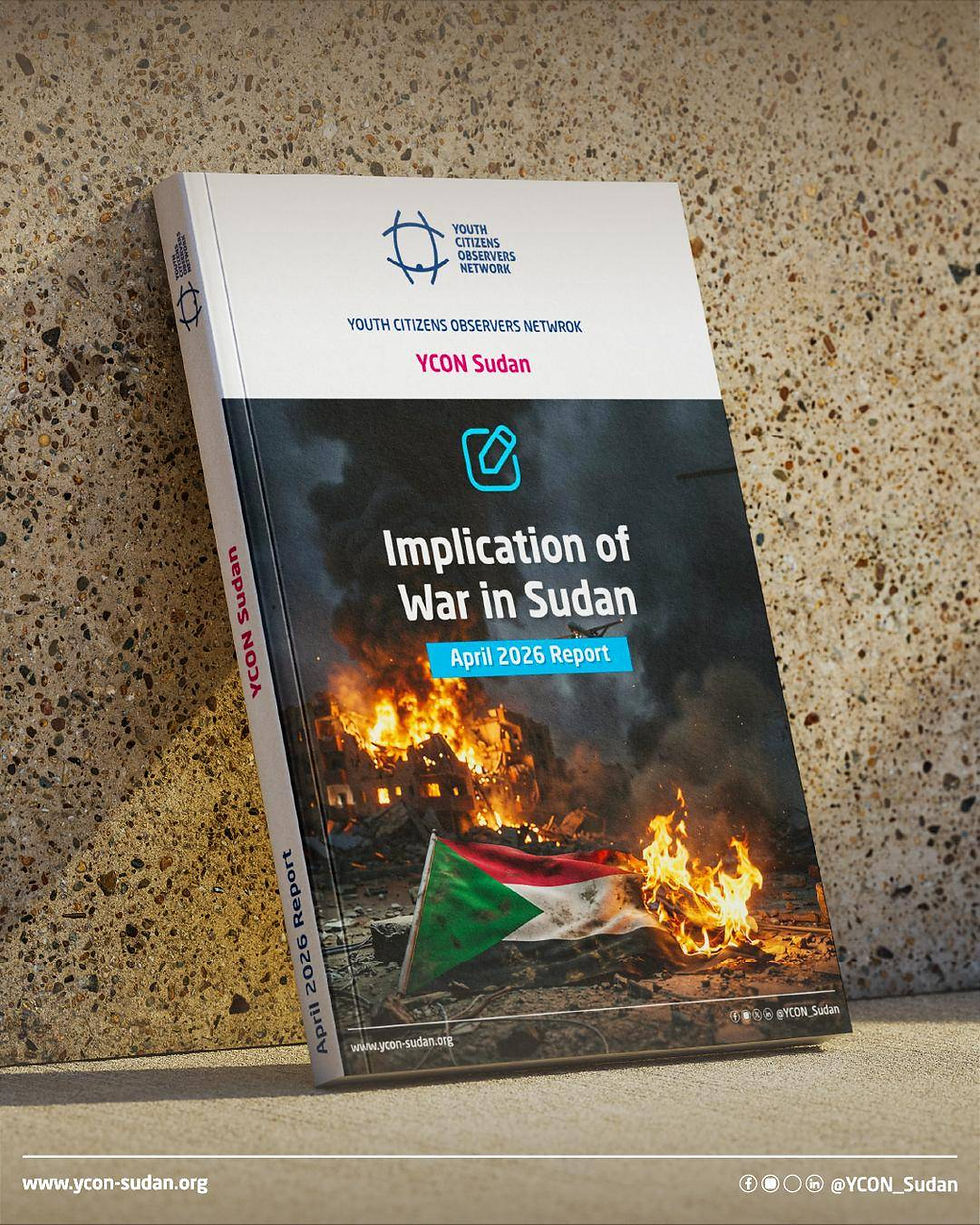
April 2026 Report
YCON's April 2026 Periodic Situational Report reflects the continued deterioration of Sudan’s crisis trajectory, with no substantive signs of improvement. Instead, April was marked by mounting pressures on civilians and the widening impact of the conflict beyond direct military confrontations to encompass the political sphere, civic freedoms, markets, public services, displacement, health, and education.
Politically and in terms of security, April witnessed a clear overlap between external political engagement and internal military escalation. The Third International Conference on Sudan, held in Berlin on 15 April, emerged as the most prominent political event of the month, taking place in the absence of the conflict’s principal parties and amid ongoing debate over the effectiveness of external political tracks, particularly given the limited civic and political space available within the country. Meanwhile, military escalation persisted across Kordofan, Darfur, and Blue Nile states, accompanied by the continued use of drones by parties to the conflict.
With regard to human rights and civilian protection, monitoring findings indicated a continued deterioration of the protection environment across several states. This was reflected in restrictions on public freedoms, ongoing arbitrary arrests, raids on public events, intimidation of activists, and the expansion of securitized practices within civic spaces. Civilians also continued to face direct violations, including killings, attacks involving explosive devices, forced displacement, kidnapping for ransom, and gender-related violations, alongside the growing threat posed by unexploded ordnance in residential areas.
Economically, the fuel crisis emerged in April 2026 as one of the key drivers of worsening living conditions. Its impact was reflected in rising commodity prices, increased transportation costs, disruptions to market activity, and setbacks to agricultural preparations and crop harvesting in some areas. At the same time, disparities between cash liquidity and bank transfer systems widened in several states.
Socially, April monitoring highlighted growing indicators of social strain across multiple regions. Hate speech based on political, ethnic, and regional identities intensified, coinciding with incidents of looting, indiscriminate gunfire, killings, and the partial spread of narcotics in certain localities.
On the humanitarian front, conditions for internally displaced persons (IDPs) and refugees continued to deteriorate across several states, with marked disparities between areas experiencing relative stability and limited interventions—such as River Nile, White Nile, and Gedaref states—and others facing repeated displacement waves alongside severe shortages in food, water, healthcare, and protection services, particularly in Darfur, Kordofan, Blue Nile, Sennar, and Kassala.
In the health sector, the report documented the continued erosion of healthcare system capacity across several states, particularly in conflict-affected and vulnerable areas. Recurring shortages of medicines for chronic illnesses, rising treatment costs, shortages of healthcare personnel, overcrowded facilities, and the spread of epidemics and seasonal diseases remained persistent challenges.
Education, meanwhile, continued to reflect one of the starkest dimensions of inequality across states. In relatively stable areas such as the Northern State, Red Sea, Gedaref, and White Nile, official examinations and educational activities continued to varying degrees. However, conflict- and displacement-affected areas—particularly Darfur, Kordofan, Khartoum, and Sennar—experienced significant disruption due to insecurity, teacher shortages, limited access to textbooks, and deteriorating learning environments.
The findings of the April 2026 report underscore that the consequences of war in Sudan can no longer be understood as isolated sectoral impacts, but rather as an interconnected, multidimensional crisis in which politics intersects with security, economic decline compounds displacement, health deterioration undermines education, and hate speech deepens the erosion of community protection mechanisms. The evidence further suggests that any meaningful response to these challenges cannot rely solely on emergency humanitarian assistance. Instead, it requires an integrated approach that links civilian protection, de-escalation of hostilities, protection of civic freedoms, livelihood support, restoration of essential services, strengthened monitoring and accountability mechanisms, and the revival of a credible political process responsive to realities on the ground.
To access the full report, please click the link below: